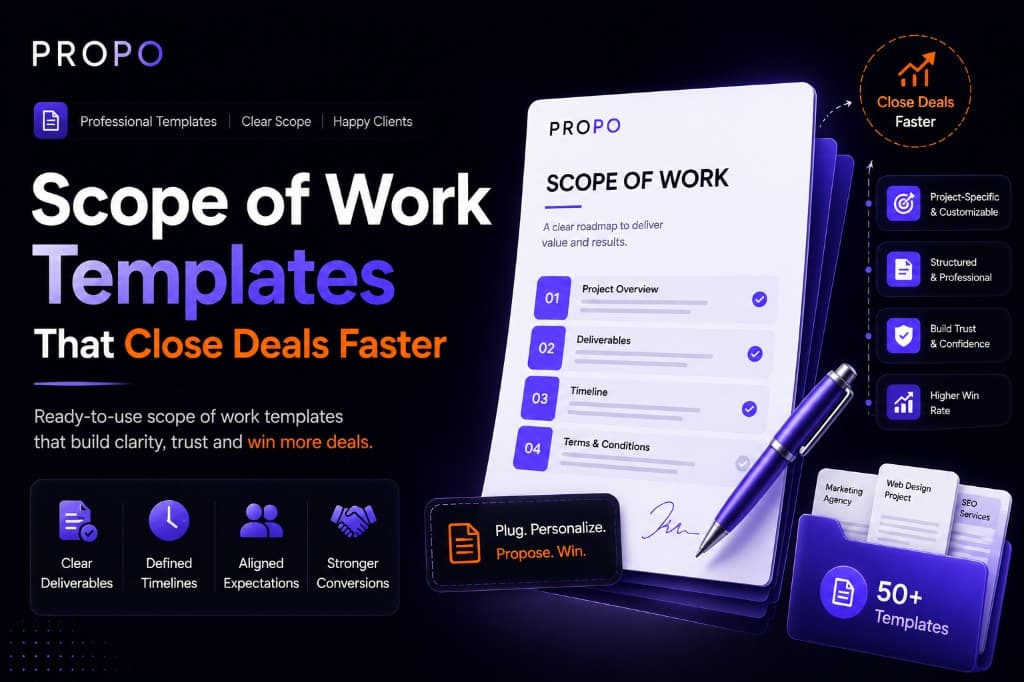
Scope of Work Templates That Close Deals Faster
The scope of work section is where most proposals either earn the client's confidence or quietly lose it.
Not the pricing. Not the credentials. The scope.
When a client reads a vague scope ("website design and development," "social media management," "branding work"), they feel uncertainty. What exactly are they getting? What isn't included? What happens if they want something slightly different? That uncertainty creates hesitation, and hesitation delays decisions.
When a client reads a specific, well-structured scope (deliverables listed clearly, phases defined, exclusions noted), they feel something different. They can picture the finished project. They know what they're paying for. They understand what you need from them to get started. That clarity accelerates decisions.
This post covers how to write a scope of work that builds confidence, includes ready-to-use templates for the most common freelance and agency service types, and explains the details that separate a scope that closes deals from one that creates more questions than it answers.
Why Most Scopes of Work Are Too Vague
The reason most freelancers write vague scopes isn't laziness. It's usually one of two things: they're afraid that being specific will limit them, or they don't want to spend time on detail before the client has said yes.
Both instincts are understandable. Both work against you.
Vague scopes don't protect you. They expose you. When deliverables aren't defined, "website redesign" can mean anything from five pages to fifty. Clients fill in the gaps with their own assumptions, and those assumptions are almost always more expansive than what you had in mind. Disputes about scope are almost always rooted in a proposal that didn't define things clearly enough.
Specificity doesn't limit you. It creates a baseline for change. A clearly defined scope doesn't prevent you from doing more. It gives you a documented starting point so that when the client asks for more, you have grounds for a change request conversation instead of an argument about what was agreed.
Clients read detailed scopes as a sign of competence. When you list twelve specific deliverables with clear descriptions, it signals that you've done this before, that you've thought through what the project actually involves, and that you're not going to disappear after the kickoff call. That confidence is worth something.
What a Good Scope of Work Includes
Before the templates, here's the anatomy of a scope section that works:
Deliverables list.Specific, enumerated outputs. Not "social media content" but "16 posts per month across Instagram and LinkedIn including static graphics, captions, and hashtag sets." Not "website" but "a 6-page responsive website including homepage, about, services, portfolio, blog index, and contact page."
What's included.Any specific features, functionality, or services that might not be obvious from the deliverable name. "Includes one round of revisions per design phase" or "includes SEO setup: meta tags, alt text, sitemap submission, and Google Search Console connection."
What's excluded.Equally important. Listing what's out of scope prevents the most common disputes. "Excludes copywriting: client to provide all page text." "Excludes third-party plugin licenses." "Excludes paid ad spend: this proposal covers setup and management only."
Dependencies.What do you need from the client to do this work? "Client to provide brand assets including logo in vector format, brand colour codes, and approved copy before design phase begins." Stated upfront, this protects your timeline and shifts the responsibility for delays appropriately.
Revision policy.How many rounds of revisions are included? What counts as a revision versus a scope change? State it clearly. "Includes two rounds of revisions per design phase. Additional revisions billed at ₹2,500 per hour."
Ready-to-Use Scope of Work Templates
The following templates cover the most common service types. Use them as starting points. Adjust quantities, phases, and specifics to match the actual project. The goal is a scope that's detailed enough to be unambiguous, not one that's exhaustive to the point of being unreadable.
Template 1: Website Design and Development
Scope of Work
Deliverables
- Design and development of a [X]-page responsive website including: [list pages, e.g. homepage, about, services, portfolio, contact]
- Mobile-optimised layout tested across iOS and Android devices
- CMS setup on [WordPress / Webflow / other] with client-editable content sections
- Contact form with email notification integration
- Basic on-page SEO setup: meta titles, meta descriptions, alt text, XML sitemap, Google Search Console connection
- Page speed optimisation targeting 85+ score on Google PageSpeed Insights
- Cross-browser testing on Chrome, Safari, Firefox, and Edge
- 30-day post-launch support for bug fixes
Included
- Up to [X] rounds of revisions per design phase
- Staging environment for client review before go-live
- Video walkthrough of the CMS on handover
Excluded
- Copywriting and content creation (client to provide all text and images)
- Logo or brand identity design
- Third-party plugin or theme licenses (billed separately at cost)
- Ongoing hosting and maintenance (available as a separate retainer)
- E-commerce functionality
Client dependencies
- Brand assets: logo in SVG/EPS format, brand colour hex codes, approved fonts
- All page copy and images delivered before design phase begins
- Domain access and hosting credentials at least 3 days before go-live
Timeline
- Discovery and planning: [X] days
- Design (wireframes + visual design): [X] weeks
- Development: [X] weeks
- Review, revisions, and launch: [X] days
- Total: [X] weeks from project kickoff
Template 2: Brand Identity Design
Scope of Work
Deliverables
- Logo design: primary logo, secondary/stacked variant, icon/monogram version
- Brand colour palette: primary and secondary colours with hex, RGB, and CMYK values
- Typography system: heading font, body font, usage guidelines
- Brand style guide (PDF): usage rules, spacing, colour, typography, do's and don'ts
- Business card design (print-ready PDF)
- Email signature template
- Social media profile image and cover templates (LinkedIn, Instagram)
- All final files delivered in AI, EPS, SVG, PNG (transparent), and PDF formats
Included
- [X] initial logo concepts
- Up to [X] rounds of revisions across all deliverables
- Final file handover with organised folder structure
Excluded
- Brand strategy, naming, or tagline development
- Website design or development
- Marketing collateral beyond items listed above
- Printing or production costs
Client dependencies
- Brand brief or questionnaire completed before work begins
- Competitor references and visual inspiration provided at kickoff
- Designated point of contact for feedback with 48-hour turnaround on review rounds
Timeline
- Discovery and brief: [X] days
- Logo concepts: [X] weeks
- Revisions and refinement: [X] weeks
- Brand guide and asset delivery: [X] days
- Total: [X] weeks from project kickoff
Template 3: Digital Marketing (Monthly Retainer)
Scope of Work
Monthly deliverables
- [X] social media posts per month across [platforms, e.g. Instagram, LinkedIn] including graphics, captions, and scheduling
- [X] blog articles per month ([X] words each), including research, writing, basic SEO optimisation, and publishing
- Monthly performance report covering reach, engagement, traffic, and lead metrics with commentary
- Paid campaign management on [Google Ads / Meta Ads]: setup, monitoring, weekly optimisation, and budget management
- Weekly status update via email or WhatsApp
Included
- Content calendar shared at the start of each month for client approval
- One strategy call per month ([X] minutes)
- Competitor monitoring and monthly insights summary
Excluded
- Ad spend (billed separately, managed through client's ad account)
- Website development or design changes
- Video production or photography
- PR, influencer outreach, or offline marketing
Client dependencies
- Monthly content approval within [X] business days of calendar submission
- Access to brand assets, ad accounts, and analytics platforms
- Product/service updates shared at least [X] days before the content calendar is due
Reporting cycle
- Monthly report delivered by the [X]th of each month
- Campaign performance reviewed in monthly strategy call
Template 4: Mobile App Development
Scope of Work
Deliverables
- Native / React Native / Flutter application for [iOS / Android / both]
- Core features: [list features, e.g. user authentication, onboarding flow, dashboard, push notifications, in-app payments]
- Backend API: [technology stack] with [database], hosted on [AWS / GCP / other]
- Admin panel for [user management / content management / reporting]
- App Store and Google Play submission assets and store listings
- Technical documentation including API specification and deployment guide
- [X]-day post-launch warranty covering defects in delivered scope
Included
- Staging and production environments
- Basic analytics integration ([Firebase / Mixpanel / other])
- [X] rounds of QA and bug-fix cycles before launch
- Knowledge transfer session on handover
Excluded
- Third-party API integration beyond [list what's included]
- Paid app store developer account fees
- Ongoing feature development post-launch (available as a separate retainer)
- Backend infrastructure costs (billed at cost through client account)
Client dependencies
- Figma designs or approved wireframes before development begins
- App Store and Google Play developer accounts registered in client name
- Timely review and approval at end of each sprint ([X]-day turnaround)
- Content, copy, and images for all in-app screens
Sprint plan
- Sprint 1 ([X] weeks): [core module, e.g. auth, navigation, data layer]
- Sprint 2 ([X] weeks): [core module, e.g. main features, API integration]
- Sprint 3 ([X] weeks): [core module, e.g. secondary features, admin panel]
- Sprint 4 ([X] weeks): QA, store submission, documentation, handover
Template 5: SEO Retainer
Scope of Work
Monthly deliverables
- Technical SEO audit (month 1) and monthly monitoring of crawl errors, Core Web Vitals, and indexing status
- [X] target keywords researched, tracked, and reported monthly
- [X] on-page optimisation updates: title tags, meta descriptions, header structure, internal linking
- [X] SEO-optimised blog articles per month ([X]+ words each), published to client CMS
- [X] backlink outreach contacts per month with tracking and reporting
- Monthly SEO report: ranking movements, traffic trends, recommendations
Included
- Initial keyword strategy and competitor gap analysis (month 1)
- Google Search Console and Google Analytics 4 setup and verification (if not already in place)
- Schema markup implementation for relevant page types
Excluded
- Paid search (Google Ads), available as a separate service
- Website redesign or development work
- Social media management
- Content beyond articles listed above (landing pages, case studies billed separately)
Client dependencies
- CMS access for publishing and on-page edits
- Google Search Console and GA4 access
- Approval of monthly content calendar within [X] business days
- Domain access for technical changes (where required)
Reporting
- Monthly report delivered by the [X]th of each month covering rankings, traffic, and activity log
Customising Templates for Each Client
A template is a starting point, not a finished scope. The difference between a template-feeling proposal and a client-specific one comes down to three things:
Swap in their actual project details. Replace every placeholder (page names, feature lists, platform names, timeline lengths) with specifics from your discovery conversation. A client reading their own project reflected back at them in your scope feels understood. A client reading a generic template feels like a number.
Adjust for what came up in the brief. Every discovery conversation surfaces something specific: a concern about timeline, a particular feature that's non-negotiable, a past bad experience with a freelancer who disappeared after kickoff. Acknowledge that in the scope. "Based on your timeline of [date], we've planned delivery to land [X] days ahead of your launch" is a sentence that only appears in a proposal written for this client.
Be honest about exclusions. Don't bury things in the exclusions list that the client might reasonably expect to be included without flagging them in the conversation. If copywriting is excluded and the client has never hired a freelancer before, they may not realise that means they're responsible for all the text. Mention it verbally and note it in the scope. Surprises at project start kill relationships.
The One Thing That Makes Scope Work
Every scope question (how detailed, how specific, what to include, what to exclude) comes back to one principle: the client should be able to read your scope and know exactly what they're getting, exactly what you need from them, and exactly what happens if something changes.
That clarity is what builds confidence. And confidence, more than price, more than credentials, more than portfolio, is what closes deals.
Generating Scopes Faster With AI
Writing a detailed scope from scratch for every proposal takes time, time most freelancers don't have when a client is waiting for a response.
Propo generates a complete scope of work as part of the full proposal (deliverables, inclusions, exclusions, dependencies, and timeline) from a brief project description. The output is structured, INR-priced, and formatted consistently across every section. For Indian freelancers and agencies, the templates are built around the kinds of projects and client relationships common in the local market, not borrowed from Western workflows.
You review the generated scope, adjust the specifics that are unique to this client and project, and send. What used to take an evening now takes fifteen minutes.
Free plan available. Pro plan at ₹499/month for freelancers, Agency plan at ₹1,499/month for studios sending regular proposals.
Final Thought
A tight scope of work isn't about protecting yourself from bad clients, though it does that too. It's about showing good clients that you've thought through every part of the project before you've even started. That thoroughness is what earns trust, accelerates decisions, and closes deals faster.
Read next: Proposal Pricing Strategies for Indian Freelancers
Win More Clients with Better Proposals
Create professional proposals for Fiverr, Upwork, and direct clients in minutes using AI-powered generation and premium templates.
Keep reading
Similar guides
More on proposals, pricing, and winning clients, picked for this topic.
Best Proposal Software for Agencies in 2026
What to look for in agency proposal software—from interactive formats and branding to pricing tables and approval workflows that help studios close more retainers.

How Agencies Can Close Clients Faster
Speed, clarity, and follow-up discipline beat longer proposals. Practical systems for scope, pricing, and interactive documents that move deals to signed.