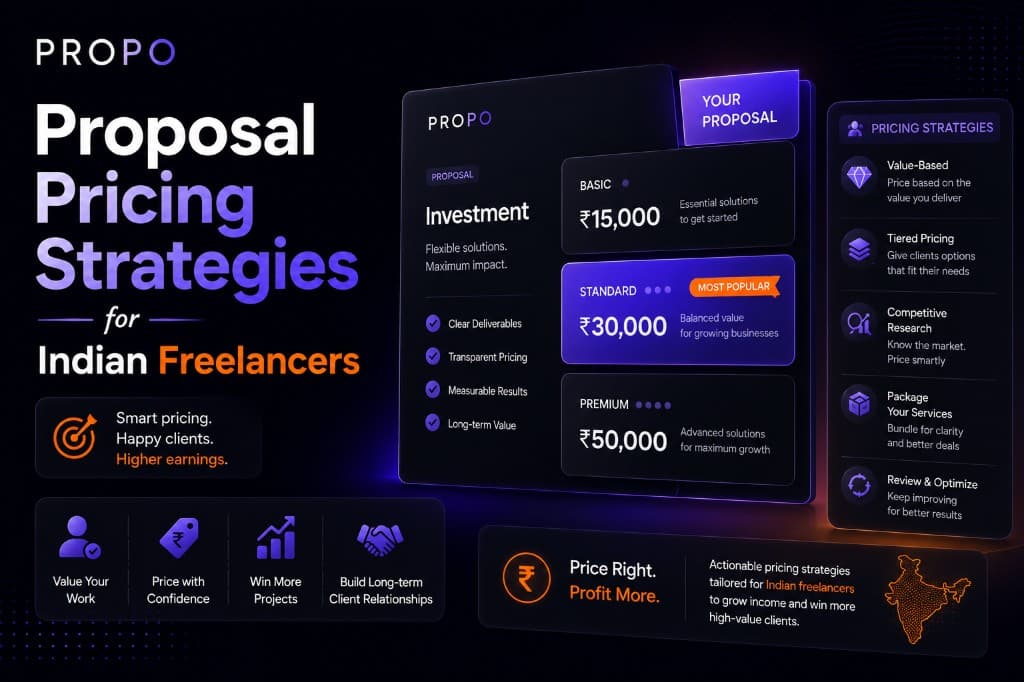
Proposal Pricing Strategies for Indian Freelancers
Pricing is the part of the proposal that most Indian freelancers get wrong, not because they don't know their worth, but because nobody ever taught them how to present it.
You can write a perfect proposal, nail the scope, demonstrate exactly the right experience, and still lose the deal because the pricing section creates doubt. A number without context feels arbitrary. A lump sum with no breakdown invites negotiation. An apology in the surrounding text signals that you don't believe your own rates.
This guide covers how to think about pricing as an Indian freelancer in 2026, how to structure it in your proposals, and how to handle the conversations that come after you send the number.
The Pricing Mindset Problem
Before getting into tactics, it's worth addressing something more fundamental.
Many Indian freelancers underprice not because the market forces them to, but because of a mindset that was shaped by the early years of Indian freelancing, when competing on cost was the primary differentiator and clients expected Indian rates to be cheap.
That market has changed significantly. Indian freelancers in 2026 are building products used globally, running campaigns for Series B startups, designing brand identities for companies that sell internationally. The "cheap Indian freelancer" narrative is outdated, and the clients worth working with have long since moved past it.
The freelancers who are stuck in underpricing are often stuck there because of internal belief, not external reality. They price low because they're afraid of rejection, afraid of appearing arrogant, afraid that a higher number will end the conversation.
Here is what actually happens when you price higher with confidence: some clients say no, some ask questions, and some say yes without negotiating at all, because the number came with enough conviction that they didn't feel the need to push back.
The goal of this guide isn't just to give you pricing structures. It's to give you a framework for thinking about pricing that removes the apology from the equation.
How to Decide What to Charge
There is no universal correct rate for any freelance service. But there are three inputs that should inform your number:
1. What the work costs you
This includes your time, not just the hours you'll spend on this specific project, but the time for client communication, revisions, project management, and the overhead of running your business. A project that involves a lot of back-and-forth, unclear requirements, or a high-maintenance client costs more of your time than a clean, well-scoped engagement.
Factor in any tools, software licenses, or contractors you'll need. Factor in the time you won't be able to spend on other work while this project is running.
2. What the outcome is worth to the client
A landing page that generates ₹10 lakhs in revenue for a client is worth more than ₹20,000. A brand identity that helps a startup raise funding is worth more than the design hours you spent on it. A mobile app that saves a company's operations team three hours per day has a calculable value.
You don't have to price at the full value of the outcome. That would often be unreasonable. But understanding the value to the client gives you a floor above which your pricing is genuinely justified, and it changes how you frame the work in the proposal.
3. What the market pays
Rates vary significantly by service, seniority, and whether you're working with domestic or international clients. Knowing the range, not to copy it, but to understand where you sit relative to it, helps you price with confidence and identify when you're leaving money on the table.
For reference, 2026 market rates for Indian freelancers doing quality work:
- UI/UX design: ₹50,000–₹2,00,000 per project depending on scope
- Web development (full project): ₹40,000–₹5,00,000
- Brand identity: ₹30,000–₹3,00,000
- Digital marketing (monthly retainer): ₹25,000–₹1,50,000
- Mobile app development: ₹1,50,000–₹10,00,000+
- Copywriting and content: ₹5,000–₹50,000 per project
These are ranges, not targets. Where you sit within a range depends on your experience, the quality of your work, your client relationships, and how well you communicate your value.
Pricing Models: Which One to Use When
There are four main pricing models freelancers use. Each works better in certain situations.
Fixed Price Per Project
You quote a single price for a defined scope of work. The client knows exactly what they're paying. You know exactly what you're delivering.
Works well when: The scope is clear, the deliverables are well-defined, and you have enough experience with similar projects to estimate accurately.
Risk:Scope creep. If the client adds requirements after you've agreed on a price, you absorb the cost unless you have a clear change request process in your terms.
Tip: Be more specific than you think you need to be in the scope definition. The more precise the deliverables, the harder it is for scope to expand without a conversation.
Milestone-Based Billing
A variation of fixed price, but payment is tied to project phases rather than a single delivery. Typical structure: 30–50% upfront, remaining in tranches tied to milestones.
Works well when: The project has natural phases (discovery, design, development, launch) and you want to reduce payment risk on longer engagements.
Why it works for clients:They pay as they see progress, which feels lower risk than paying a large amount upfront for something they haven't seen yet.
Why it works for you:You're not waiting until final delivery to get paid, and a client who's invested through multiple milestones is less likely to walk away mid-project.
Monthly Retainer
A fixed monthly fee for ongoing work: a defined number of hours, a defined set of deliverables, or a defined set of outcomes per month.
Works well when:You're doing ongoing work that doesn't fit neatly into individual projects (social media management, SEO, content creation, ongoing development support).
The advantage over project-based work: Predictable income. A few retainer clients change the financial texture of freelancing significantly.
How to price it:Start by estimating the realistic hours per month, add buffer for communication and management overhead, and multiply by your effective hourly rate. Don't price a retainer at less than a standalone project would cost just because it's recurring. Ongoing availability has value.
Value-Based Pricing
Instead of pricing based on hours or deliverables, you price based on the value the work creates for the client.
Works well when:The client's business impact is clear and significant: a campaign that will drive ₹50 lakhs in sales, an app that will reduce operational costs by ₹10 lakhs per year, a website that will open an enterprise sales channel.
The challenge: This requires a confident conversation about business outcomes and the ability to connect your work to measurable results. Most clients are open to it once the logic is clear.
A simple way to start:Instead of quoting ₹60,000 for a landing page, quote ₹60,000 framed as "designed to improve conversion rate and reduce cost-per-lead from your existing ad spend." You're still charging ₹60,000. You're just anchoring it to an outcome rather than a deliverable.
How to Structure Pricing in Your Proposal
How you present pricing matters as much as the number itself.
Use a line-item breakdown, always.A single number with no context (₹1,20,000) forces the client to evaluate it blindly. A breakdown shows them what they're paying for, makes each line item feel reasonable, and shifts the conversation from "is this too expensive" to "does this scope make sense."
A clean breakdown for a website project might look like:
| Item | Details | Amount (INR) |
|---|---|---|
| Discovery & planning | Kickoff call, requirements doc, sitemap | ₹10,000 |
| UI/UX design | Wireframes, design system, 5 page designs | ₹35,000 |
| Development | Responsive build, CMS setup, contact form | ₹55,000 |
| Testing & launch | Cross-browser QA, staging, go-live support | ₹15,000 |
| Total | ₹1,15,000 + GST |
State GST clearly. For domestic clients in India, include a note on whether your pricing is inclusive or exclusive of GST. Surprises at invoice time damage trust. Clarity upfront prevents the conversation from going sideways later.
State payment terms explicitly. Don't leave payment structure to a follow-up discussion. Include it in the proposal: "50% advance to begin, 50% on final delivery. Payment via NEFT, UPI, or Razorpay. Advance invoice raised within 24 hours of proposal acceptance."
Name the payment method.This is a small detail that makes a real difference for domestic proposals. Stating "UPI or Razorpay" is more friction-free for an Indian client than "bank transfer." It signals that you've thought about how they actually pay.
Avoid the word "cost."Frame your pricing as an investment. "Project investment: ₹1,15,000 + GST" reads differently than "Project cost: ₹1,15,000." Small language change, different psychological framing.
Handling Price Pushback
Pushback on pricing is normal. How you handle it determines whether the deal closes or falls apart.
Don't immediately discount.The first response to "this is a bit above our budget" should never be "okay, I can do it for less." That tells the client that your original price was inflated and that pushing back works. It also trains them to push back on every future engagement.
Understand what's actually being said. "This is above our budget" often means one of three things: it's genuinely outside their budget, they want to see if you'll negotiate, or they're not convinced the work is worth the price. These require different responses.
If it's a genuine budget constraint, offer a reduced scope rather than a reduced rate. "I can deliver the core five pages within ₹80,000. We'd remove the blog and case study sections for now and add those in a Phase 2." You're still pricing your time correctly. You're just doing less of it.
If they want to negotiate,hold your rate and justify it. "The pricing reflects the specific scope and timeline you mentioned. I've built in enough time to do this properly rather than rushing. I'm confident in the number." Sometimes that's enough.
If they're not convinced of the value, that's a proposal problem, not a pricing problem. It means the connection between your work and their outcome wasn't clear enough. Ask what their concern is and address it directly.
Know your walk-away number.Before entering any pricing conversation, know the minimum you'll accept. Not as a starting point for negotiation, but as a line you won't cross. Working below that number breeds resentment and produces worse work. It's better to pass on a project than to deliver it at a rate that makes you miserable.
The "Cheap Indian Freelancer" Trap and How to Escape It
International clients sometimes arrive with the expectation that Indian freelancers are significantly cheaper than their Western counterparts. Some Indian freelancers reinforce this expectation by pricing accordingly.
The trap is a race to the bottom. You win projects at ₹15,000 that should be ₹60,000. You take on more projects to compensate. You have less time to do good work. Your quality suffers. Your reputation doesn't grow. You stay stuck.
Escaping it requires a deliberate repositioning. Raise your rates. Improve your proposal quality. A well-written, professionally structured proposal makes a ₹60,000 quote feel more credible than a casual one-liner would. Build a portfolio that demonstrates the quality of your work at a level that justifies higher prices. Get case studies with outcomes, not just screenshots.
The international clients worth working with are not choosing you because you're cheap. They're choosing you because you're good, you communicate well, and you deliver reliably. Price accordingly.
Tools That Make Proposal Pricing Easier
Putting together a clean, itemised pricing table from scratch for every proposal is time-consuming. Most freelancers end up with inconsistent formats, redone from a different template each time, that don't look as polished as the rest of the proposal.
Propo handles this natively. The AI generates a structured proposal including a formatted INR pricing table, broken into line items, with totals and payment terms built in, from a brief project description. The output is consistent, professional, and already formatted the way clients expect.
For Indian freelancers specifically, the INR-native pricing, GST-aware formatting, and Razorpay-compatible payment term language make it a better fit than tools built around USD and Western billing workflows. Free plan available, Pro plan at ₹499/month for freelancers sending regular proposals.
Price Like You Mean It
Confident pricing isn't arrogance. It's a signal, to the client, and to yourself, that you take your work seriously.
The freelancers who charge well aren't the ones who found some secret rate list. They're the ones who stopped apologising, started presenting their pricing clearly, and discovered that most of the resistance they feared was in their own head.
Write the number. Explain what it includes. State the payment terms. Stop.
The clients who are right for you will say yes.
Read next: How to Write Winning Freelance Proposals in India (2026 Guide)
Win More Clients with Better Proposals
Create professional proposals for Fiverr, Upwork, and direct clients in minutes using AI-powered generation and premium templates.
Keep reading
Similar guides
More on proposals, pricing, and winning clients, picked for this topic.
How To Create Winning Client Proposals
Shift from agency-focused pitches to client-focused proposals: discovery, structure, writing principles, and mistakes that cost you the deal.
How to Write Winning Freelance Proposals in India (2026 Guide)
A practical framework for Indian freelancers and agencies to write clear, credible proposals that win clients on Upwork, Fiverr, and direct leads.