How to Write Winning Freelance Proposals in India (2026 Guide)
Winning freelance work in India has never been more competitive. Clients have more options than ever on Upwork, Fiverr, LinkedIn, and through direct referrals, and the ones worth working with know it. They're not picking the cheapest option or the fastest reply. They're picking the freelancer who makes them feel most confident that the work will actually get done.
Your proposal is where that confidence is built or lost.
This guide is written specifically for Indian freelancers in 2026, whether you're pitching on Upwork, responding to Fiverr briefs, or sending direct proposals to clients in Mumbai, Bangalore, Delhi, or anywhere else. The principles are universal but the context matters, and most proposal guides online are written for Western markets with USD pricing and client expectations that don't always translate.
Why Most Freelance Proposals Don't Win
Before covering what works, it helps to understand what doesn't, because the same mistakes show up across thousands of proposals every day.
The proposal is about the freelancer, not the client. "I am a skilled developer with 5 years of experience and expertise in React, Node.js, and..." This opening tells the client nothing about their project. It tells them about you. By the time you get to the project, they've already mentally moved on.
It's too generic.Clients can tell when a proposal was copied from a template and minimally adjusted. They can tell when the scope description doesn't match what they asked for. They can tell when the pricing has nothing to do with the brief. A generic proposal signals that you didn't care enough to write a real one.
It doesn't answer the real question. Every client reading a proposal is asking one thing: can this person actually solve my problem? A proposal that lists skills and services without demonstrating understanding of the specific problem doesn't answer that question.
The ask is unclear."Let me know if you'd like to discuss further" is not a next step. It puts the burden on the client to initiate a conversation that you should be leading.
Fix these four things and you're already ahead of most of the competition.
Understanding the Indian Freelance Landscape in 2026
The Indian freelance market has matured significantly. Clients, both domestic and international, have worked with Indian freelancers long enough to have clear expectations, and those expectations have risen.
Domestic clients are more sophisticated. Indian startups, D2C brands, SaaS companies, and agencies have worked with freelancers and small studios for years now. They know what a good proposal looks like. They know when scope is vague. They know when pricing is padding. A proposal that would have impressed a client five years ago is now the baseline.
International clients expect professionalism but value locality. On platforms like Upwork and Fiverr, Indian freelancers compete globally. The price advantage is narrowing as more international clients prioritise communication quality, reliability, and professionalism over cost. A strong proposal, well-written, clearly structured, demonstrating genuine understanding, closes that gap.
INR pricing and payment clarity matter for domestic work. Proposals sent to Indian clients should reflect INR pricing, Indian tax considerations (GST where applicable), and payment workflows that make sense locally: NEFT, UPI, Razorpay. A proposal built on a USD template creates friction and signals that you're using borrowed tools.
Response speed is increasingly a differentiator. Good clients in India receive multiple proposals for every project. The freelancer who responds thoughtfully within a few hours, not a few days, consistently wins more work than slower competitors with comparable skills.
How to Write a Proposal That Wins
Step 1: Read the Brief Twice Before Writing Anything
This sounds obvious. Most freelancers skip it.
Read the brief once for the surface request: what does the client say they want. Read it again for the underlying need: what are they actually trying to achieve, what problem is driving this project, what does success look like for them.
The second reading changes what you write. A client asking for a "landing page redesign" might really be asking for better conversions from their ad traffic. A client asking for "social media content" might really be trying to establish credibility with enterprise buyers. Understanding the why gives your proposal a completely different quality.
If the brief is vague, ask one or two focused questions before writing. "Before I put together a proposal, can I ask: are you prioritising getting this done quickly, or is there flexibility on timeline if it means a better result?" A thoughtful question signals intelligence and earns you information that makes your proposal stronger.
Step 2: Open With Their Problem, Not Your Profile
The first paragraph of your proposal sets the tone. Most freelancers open with their credentials. The ones who win open with the client's situation.
Compare these two openings:
"Hi, I'm a full-stack developer with 6 years of experience specialising in React and Node.js. I've worked with clients across fintech, edtech, and e-commerce..."
vs.
"You're dealing with a checkout flow that's losing users at the payment step. Based on what you've described, the issue is likely a combination of too many form fields and the lack of UPI as a payment option. Here's how I'd approach fixing it."
The second opening tells the client you actually read their brief, understood the problem, and have already started thinking about the solution. That's the freelancer they want to hire.
Step 3: Be Specific About What You'll Do
Scope is where proposals either build trust or create doubt.
Vague scope: "I will design and develop your website."
Specific scope: "I will design and develop a 5-page responsive website: homepage, about, services, portfolio with 6 case studies, and contact, built in Webflow, optimised for mobile, with a basic SEO setup including meta tags, sitemap, and page speed optimisation. Delivered in 3 weeks from kickoff."
The specific version answers a dozen questions the client would otherwise need to ask. It makes the project feel real. And it protects you. If the client later asks for something outside this scope, you have a clear baseline to reference.
Step 4: Price With Confidence
Pricing is where many Indian freelancers undermine themselves.
Underpricing to win the project is a trap. It attracts clients who are focused on cost, makes it harder to raise rates later, and sets an expectation that you'll continue to work cheap. The clients worth working with are not the ones choosing the lowest bid.
A few things that make pricing land better:
Break it into line items. A single number with no context is easy to push back on. A breakdown (discovery and planning, design, development, content integration, testing and launch) gives the client context. Each line item feels reasonable even if the total is the same.
Anchor to outcomes."₹85,000 for a conversion-optimised landing page" lands better than "₹85,000 for a landing page." The outcome makes the price feel like an investment rather than a cost.
State payment terms clearly. 50% advance, 50% on delivery. Or milestone-based billing. Whatever your structure, state it plainly. Ambiguity around payment invites negotiation and disputes.
Don't apologise for your rates. "I know this might seem a bit high but..." signals that you don't believe your own pricing. State the number, explain what it includes, and stop. If the client has questions about pricing, they'll ask.
Step 5: Show Relevant Proof
You don't need a 10-year portfolio to close a client. You need one or two pieces of evidence that are relevant to their specific project.
If you're proposing a website redesign for an e-commerce brand, mention a similar project you've done and what it achieved. If you can share a link, share it. If you have a number ("reduced bounce rate by 40%" or "launched on time despite a 2-week scope change mid-project"), use it.
Relevance matters more than volume. Three specific, relevant examples beat ten generic ones every time.
If you're early in your career and don't have direct client examples, use personal projects, spec work, or pro-bono work that demonstrates the relevant skills. Something real is always better than nothing.
Step 6: Make the Next Step Obvious
Every proposal should end with a clear, specific call to action.
Not: "Looking forward to hearing from you."
But: "If this looks right to you, reply to confirm and I'll send the advance invoice within 24 hours. We can kick off the project by [date]."
Or: "I'm available for a 20-minute call on Tuesday or Wednesday to walk through the proposal and answer any questions. Let me know what time works."
A specific next step removes the mental effort of figuring out what to do. It moves the proposal from a document to a conversation.
Writing Proposals for Upwork and Fiverr
Platform proposals have their own context. Clients on Upwork and Fiverr are often evaluating five to fifteen proposals at once. The way you structure a platform proposal needs to account for that.
Lead with the problem, not a greeting. "Hi, I saw your project and I'd love to help!" is the opening line of most platform proposals. Skip it. Open with a one-sentence statement of what you understood the client's problem to be. It immediately distinguishes your proposal from the others.
Keep it shorter than you think. Platform clients don't read long proposals. They scan. Two or three focused paragraphs covering the problem, your approach, and the proposed outcome is more effective than a detailed document. Save the detail for a follow-up message once they've engaged.
Reference something specific from their brief. The more specific you can be about their project (a detail they mentioned, a constraint they flagged), the more your proposal stands out. It proves you read the whole thing, which many applicants don't.
End with a question.Not just a next step, but a question that invites a reply. "Does this approach match what you had in mind?" or "What's your priority, speed or cost on this one?" A question starts a conversation. A conversation gets you hired.
Using AI to Write Proposals Faster Without Losing the Personal Touch
AI tools have genuinely changed how fast a solid proposal can come together. What used to take two hours can now take fifteen minutes: a structured draft with relevant sections, pricing tables, and clear scope, generated from a brief description of the project.
The risk is using AI as a replacement for thinking rather than as a starting point. A proposal where you've replaced every detail with what an AI generated, including the client's problem statement and the proposed solution, reads like a generic template. Clients notice.
The better approach: use AI to generate the structure and boilerplate, then personalise every section that matters. The executive summary should be in your words, reflecting what you understood from the brief. The scope should reflect the actual conversation. The pricing should make sense for this project, not a generic version of it.
Propo is built for exactly this workflow. It generates a complete, structured proposal from a brief project description (INR pricing, milestone timelines, scope sections, terms) and applies your branding automatically. You review, personalise the sections that need to reflect this specific client, and send. The boilerplate is handled; the thinking is still yours.
For Indian freelancers and agencies, the INR-native pricing, Razorpay-friendly payment terms, and templates built around common Indian project types (web design, mobile apps, digital marketing, branding) make it a closer fit than most tools built for Western markets. Free plan available, with paid plans starting at ₹499/month.
A Proposal Template You Can Use Today
Here's a simple structure that works for most freelance proposals:
- Opening (2–3 sentences):State the client's problem in your own words. Show you understood the brief.
- Proposed approach (3–4 sentences): What you're recommending and why this approach is right for their situation.
- Scope of work (bulleted list): Specific deliverables, clearly listed. No vague terms.
- Timeline: Total duration and key milestones.
- Investment: Line-item breakdown, total in INR, payment terms.
- Relevant experience (2–3 lines): One or two specific examples relevant to this project.
- Next step: One clear action for the client to take.
That's it. A proposal built on this structure, written with genuine attention to the client's specific situation, will outperform most of the competition.
The Freelancers Who Win Consistently
The Indian freelancers who close the most proposals aren't necessarily the most skilled or the most experienced. They're the ones who take the proposal seriously as a communication exercise, not just a formality.
They write for the client, not for themselves. They're specific when others are vague. They price with confidence when others hedge. They follow up when others wait.
The proposal is often the only thing that stands between you and the work you want. Treat it like it matters, because it does.
Read next: How To Create Winning Client Proposals
Win More Clients with Better Proposals
Create professional proposals for Fiverr, Upwork, and direct clients in minutes using AI-powered generation and premium templates.
Keep reading
Similar guides
More on proposals, pricing, and winning clients, picked for this topic.
How To Create Winning Client Proposals
Shift from agency-focused pitches to client-focused proposals: discovery, structure, writing principles, and mistakes that cost you the deal.
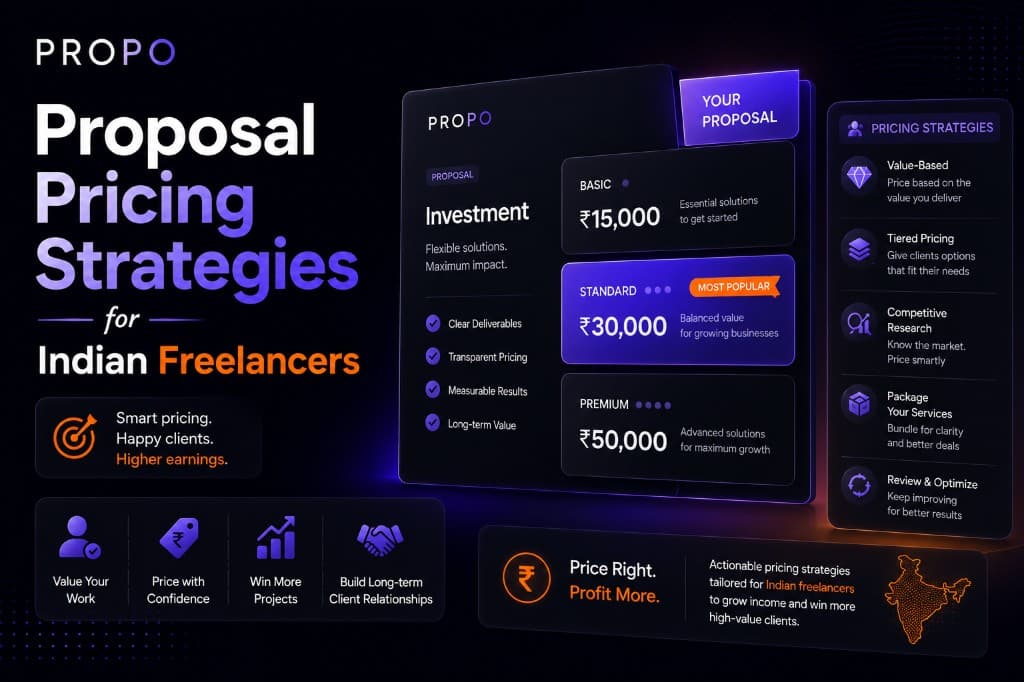
Proposal Pricing Strategies for Indian Freelancers
How to present INR packages, milestones, and revision limits in proposals so clients understand value without endless negotiation.